A straightforward paranormal story can tell us that something impossible happened. A strong mystery does something more interesting: it leaves evidence behind.
That is what separates many of the best supernatural mystery books from stories built only around ghosts, curses, or unexplained phenomena. The reader is not simply asked to accept the impossible. We are given a death that makes no sense, a missing record, a message nobody can explain, or two historical accounts that cannot both be true. Then we are invited to investigate.
Supernatural thriller novels add another layer. Once the clues begin to connect, the question is no longer only what happened. It becomes whether someone concealed the truth, whether the danger still exists, and what happens to the person who gets close enough to uncover it.
For me, that is where hidden history becomes most interesting. The past stops being background and becomes evidence.
The Best Supernatural Mysteries Begin With Something That Should Be Impossible
Every worthwhile mystery needs a fracture in the ordinary world.
It may be an unexplained death. A missing captain’s log. An impossible survivor. A strange artifact. Contradictory dates. A coded message whose most important words were dismissed as nonsense.
The strange detail has to create a question.
If a ship’s crew is found dead without obvious injuries, what killed them? If reports place the same disaster in different years, which account is reliable? If one survivor appears after everyone else is presumed dead, what did he see? If a message contains a phrase investigators ignored, was it meaningless—or the most important clue?
An unexplained event is unsettling. An unexplained event surrounded by conflicting evidence becomes a puzzle.
Why Historical Evidence Makes Supernatural Mystery Books More Convincing
Historical evidence gives readers something solid to hold while the story moves toward the impossible.
Newspaper archives, passenger manifests, military documents, personal letters, government records, eyewitness accounts, and historical societies can establish what was recorded before asking what may have been omitted.
The strongest supernatural mystery books do not treat a document as proof of the supernatural. They treat it as a starting point. A manifest may tell us where cargo came from without explaining why it mattered. A military record may confirm that a person or unit existed without explaining every event connected to it. A newspaper may preserve a detail later accounts leave out.
Sometimes the gap between two records is more interesting than either record by itself.
That is the appeal of an evidence-driven historical mystery. Readers can follow the same trail as the investigator and decide where documented history ends and speculation begins.
The Investigator Is Just as Important as the Supernatural Threat
A supernatural threat can be frightening, but a mystery needs someone willing to keep asking questions.
The investigator finds a detail that does not fit, searches for the original source, and discovers another name, date, artifact, battle, or location. Something that first looked unrelated begins to form a pattern.
The best investigators in mystery thriller books are persistent. They know a clue can be wrong, incomplete, mistranslated, hidden, or misunderstood. They also know when coincidence begins to happen too often.
That process creates the real momentum. We are not watching the strange from a distance. We are trying to understand it at the same time as the person on the page.
How Supernatural Thriller Novels Raise the Stakes
Mystery asks: What happened?
Thriller asks: What happens if the truth is discovered?
Supernatural thriller novels take the investigation and put pressure on it. A hidden record may point to a conspiracy. A mysterious artifact may have passed through governments, military programs, collectors, or people who understood its significance long before the investigator did.
Forbidden knowledge can create pursuit, secrecy, dangerous discoveries, and escalating consequences.
The threat may also be larger than one incident. If the same unexplained phenomenon appears in different places and periods, the investigator must consider an uncomfortable possibility: perhaps the danger never ended.
A good thriller makes discovery costly. The closer the investigator gets to the answer, the more dangerous the answer becomes.
When the Clues Stretch Across Generations
A mystery becomes harder to dismiss when its clues are separated by decades or centuries.
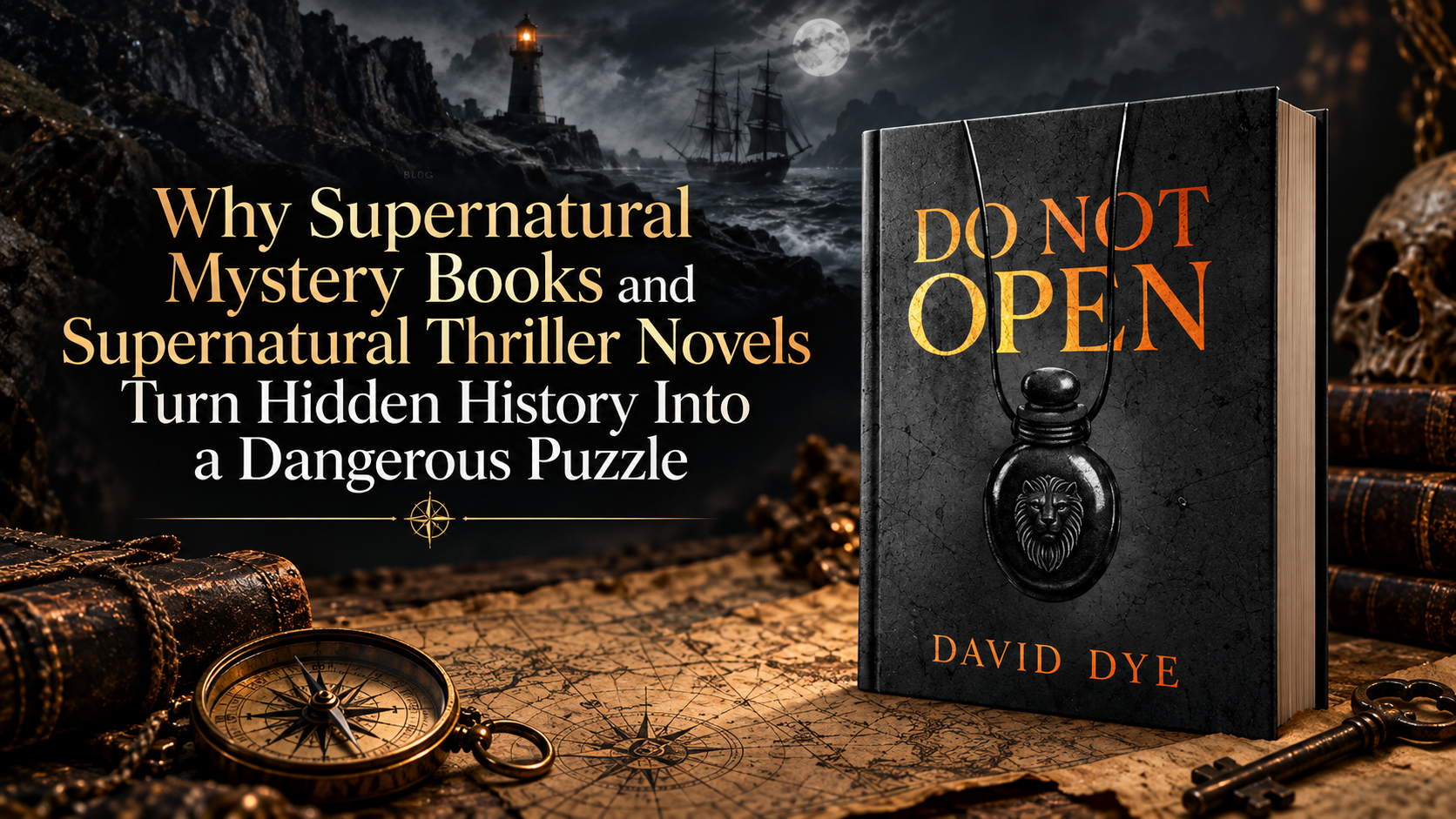
That structure is central to Do Not Open. The novel moves between a present-day investigation and historical periods involving 1947, World War I, World War II, Unit 731, Nazi Germany, and ancient Egypt. Events from different eras gradually begin to connect.
This makes history itself part of the puzzle.
A clue discovered in the present may only make sense after the story returns to an earlier war. A wartime record may point backward to an older artifact. A maritime mystery may connect to people who never knew the ship existed.
The suspense comes from pattern recognition. The reader begins asking the same question as the investigator: How can events separated by generations belong to the same story?
The Line Between Historical Mystery and Supernatural Explanation
This is the tension I find most compelling.
Is there a logical explanation that has simply been lost to history, or is the supernatural explanation the missing piece?
Good supernatural mystery books should resist answering too quickly. History is incomplete. Records are destroyed. Witnesses die. Governments classify information. Newspapers repeat mistakes. Stories change as they are retold. An apparently paranormal event may have a rational explanation that was never preserved.
But what if the ordinary explanation was never enough?
Supernatural thriller novels work best in that narrow space. They do not need to reject history or science. They can use both to define the limits of what is known—and then ask what remains outside those limits.
That uncertainty is what turns an unexplained historical event into something more disturbing.
What Readers of Supernatural Mystery Books Really Want
Readers drawn to this genre are rarely looking for a supernatural event alone. They want a puzzle worth solving.
They want genuine uncertainty, dark history, atmospheric suspense, contradictory evidence, hidden motives, ancient secrets, and discoveries that create better questions instead of easy answers. They want an occult mystery or paranormal element grounded enough to feel possible.
Most of all, they want participation.
A clue should make the reader reconsider what came before. A recovered document should change the meaning of an earlier event. An unexplained historical incident should feel plausible enough to research after the book is closed.
That is when supernatural suspense lasts. The story may end, but the question does not.
Do Not Open and the Mystery Hidden Inside History
Do Not Open grows from exactly that kind of question: what happens when a historical mystery contains one detail that refuses to fit?
The novel moves through maritime legend, conflicting accounts, wartime history, Unit 731, ancient mythology, coded messages, and an artifact whose trail reaches far beyond a single ghost ship. Records, testimony, documents, and unexplained events become parts of the investigation rather than background decoration.
The result combines the appeal of historical conspiracy, paranormal mysteries, ancient secrets, and supernatural investigation without requiring readers to abandon the real world in order to enter the story.
That is why hidden history works so well in supernatural mystery books and supernatural thriller novels. The past already contains gaps. Fiction can enter those gaps without removing the uncertainty that made them fascinating in the first place.
The most dangerous puzzle is not always the one with no answer. Sometimes it is the one where every new answer proves that the mystery is much older—and much closer—than anyone believed.