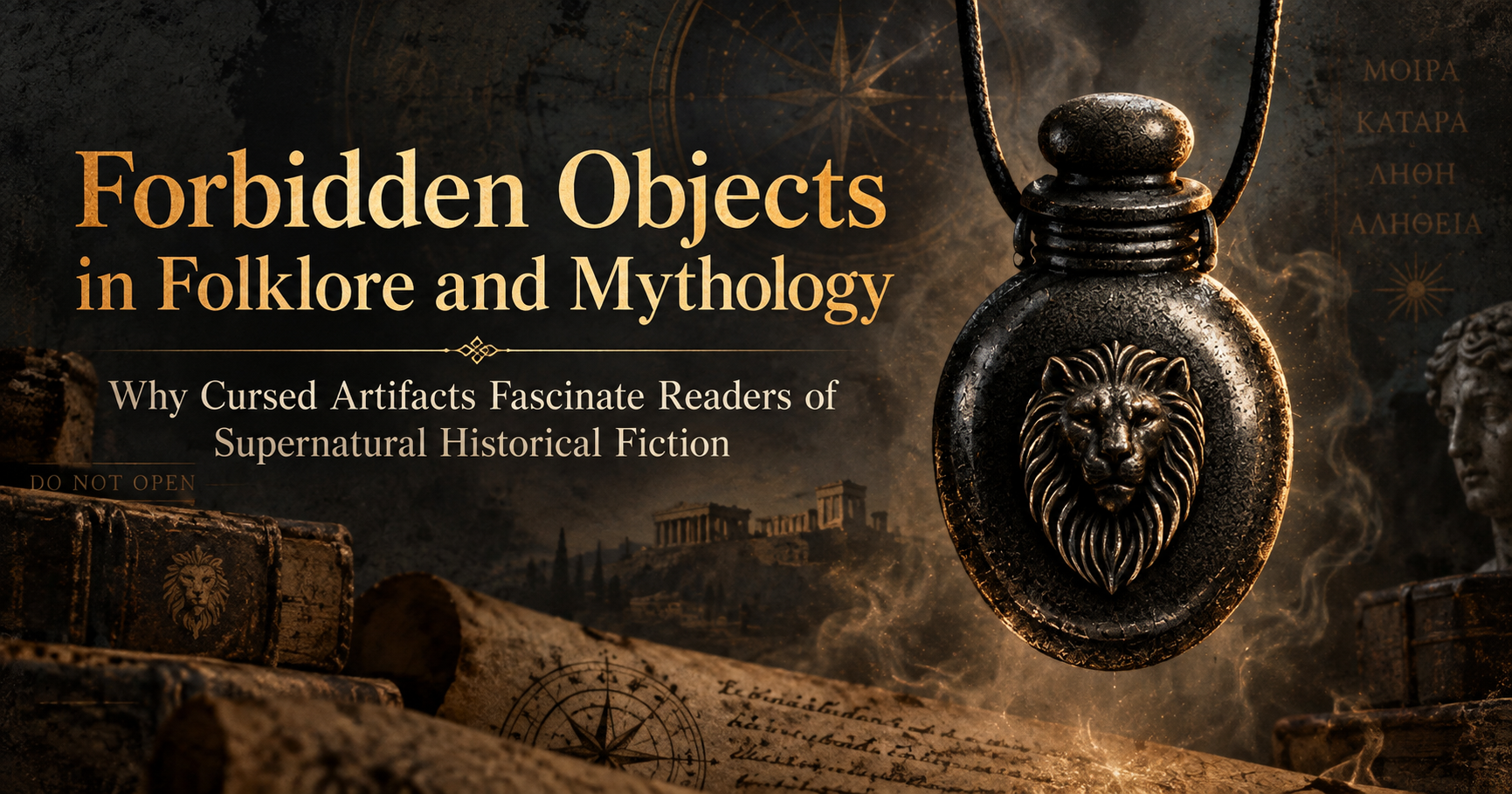
Across cultures and centuries, people have told stories about objects that should not be touched, opened, worn, moved, stolen, or disturbed. Sometimes it is a sealed vessel; sometimes jewelry, a burial object, a religious relic, or an ancient amulet. The form changes, but the warning remains familiar: leave it alone.
Forbidden objects remain powerful in folklore and mythology because they give the unknown a physical form. A curse cannot be held. An artifact can be hidden, stolen, cataloged, shipped, inherited, buried, or opened. Once that object is placed inside a recognizable historical period, it becomes more than a supernatural device. It becomes evidence.
That is why cursed artifacts work so well in supernatural historical fiction.
Why Folklore and Mythology Give Ordinary Objects Extraordinary Power
An object does not have to look frightening to become frightening. Some of the most effective mythological objects are small enough to fit in a pocket or hang from a necklace.
Historically, amulets and talismans were not simply decorative. In ancient Egypt, amulets could represent deities, animals, symbols, or objects, and their perceived power could come from material, color, inscription, shape, or ritual use. They were worn by the living and placed with the dead for purposes that included protection and regeneration. Ancient Greece and Rome also left behind curse tablets—physical objects inscribed with appeals for supernatural forces to bring misfortune upon another person.
This is what makes folklore and mythology so useful to fiction. A relic may be sacred to one person, valuable to another, politically useful to a ruler, and terrifying to someone who knows the warning attached to it.
The object stays the same. Its meaning changes with whoever holds it.
The Fear Behind the Forbidden Artifact
Why does a warning make us want to know what is behind it?
“Do not touch” creates the question: what happens if I do? “Do not open” creates an even stronger one: what is inside?
Stories about forbidden relics depend on the conflict between caution and curiosity. We are drawn to hidden knowledge, especially when someone tells us that knowledge is dangerous. The warning itself suggests there is something worth discovering.
Was the warning supernatural, or did it preserve knowledge later generations no longer understood? Was a burial object cursed, or was the story meant to keep intruders away? Was a sealed vessel feared because of superstition, or because someone once knew what it contained?
That uncertainty is more unsettling than a simple answer.
When Mythological Objects Enter Real History
A cursed artifact becomes more convincing when it has a trail.
In supernatural historical fiction, that trail might pass through an archaeological site, battlefield, private collection, government archive, ship’s manifest, or family estate. Each stop gives the object another layer of provenance.
A soldier may see a trophy. An archaeologist sees an artifact. A government sees leverage. A scientist sees an unexplained phenomenon. A believer sees a warning everyone else is too arrogant to recognize.
The same object can move across centuries while its interpretation changes with the people, politics, and knowledge surrounding it.
History supplies the record. Folklore supplies the possibility that the record is incomplete.
Ancient Talismans, Occult Beliefs, and the Search for Power
Human beings have long carried objects believed to protect, heal, curse, bless, or influence events. That matters because supernatural historical fiction is most convincing when the invented element grows from beliefs that real people once held.
In Do Not Open, the central artifact eventually enters the world of wartime power. The manuscript describes a strange granite amulet or vessel, unusually heavy for its size, apparently hollow, marked with ancient characters, and engraved with the head of a lioness. Its age and origin are uncertain, and different people react to it differently.
The story then places the object before people who do not merely want to understand it. They want to know whether it can be used. Curiosity asks, “What is this?” Power asks, “What can this do for me?”
Within the novel, Nazi interest turns the artifact into a strategic question, while later examination treats its effects almost like something that could be measured, controlled, and directed.
Why Cursed Artifacts Work So Well in Supernatural Historical Fiction
Cursed artifacts solve several storytelling problems at once:
- They physically connect different eras, owners, wars, and locations.
- They create an ongoing mystery because each holder learns only part of the story.
- They allow different cultures to interpret the same object through religious, scientific, political, or mythological beliefs.
- They keep readers uncertain about where historical fact ends and supernatural explanation begins.
A strong forbidden artifact does more than cause strange events. It accumulates history. An inscription, missing record, battlefield story, shipping route, or unexplained death can become part of its biography.
When Folklore Leaves Behind a Historical Trail
This is the territory Do Not Open explores most naturally.
The story begins not by demanding belief in a magical object, but with a maritime mystery, an SOS, a dead crew, missing information, and a warning that does not seem to belong. The investigation then moves through mythology, wartime events, historical research, secret programs, and an ancient object whose significance becomes more disturbing as its trail grows.
That structure reflects a recurring idea in the manuscript: myths can survive because some fragment of truth may remain after the original explanation has been lost.
The lioness-shaped object works because it is not isolated from history. It passes through different periods and institutions, and each encounter adds another question. Even the people examining it disagree about what they are experiencing, while its construction, age, and warning resist easy explanation.
The artifact is not simply declared cursed. Its history has to make the accusation.
Why Readers Still Search for the Truth Behind Ancient Legends
The appeal of ancient legends is not that every story can be proven true. Most cannot.
What keeps us searching is that some stories leave behind enough geography, objects, documents, coincidence, or cultural memory that they cannot be dismissed as easily as we would like.
That is the narrow space where folklore and mythology become irresistible. A historian wants documentation. A scientist wants a mechanism. A believer may already have an explanation. Supernatural historical fiction can put all three together and ask which one is missing something.
A cursed artifact is perfect for that purpose because it is both symbol and evidence. It can be weighed, translated, buried, stolen, and passed from one generation to another. Yet none of those actions necessarily explains what people believe it can do.
Perhaps that is why forbidden objects still fascinate us. The most compelling legend is not always the one we can prove true.
Sometimes it is the one history has never quite allowed us to prove false.